
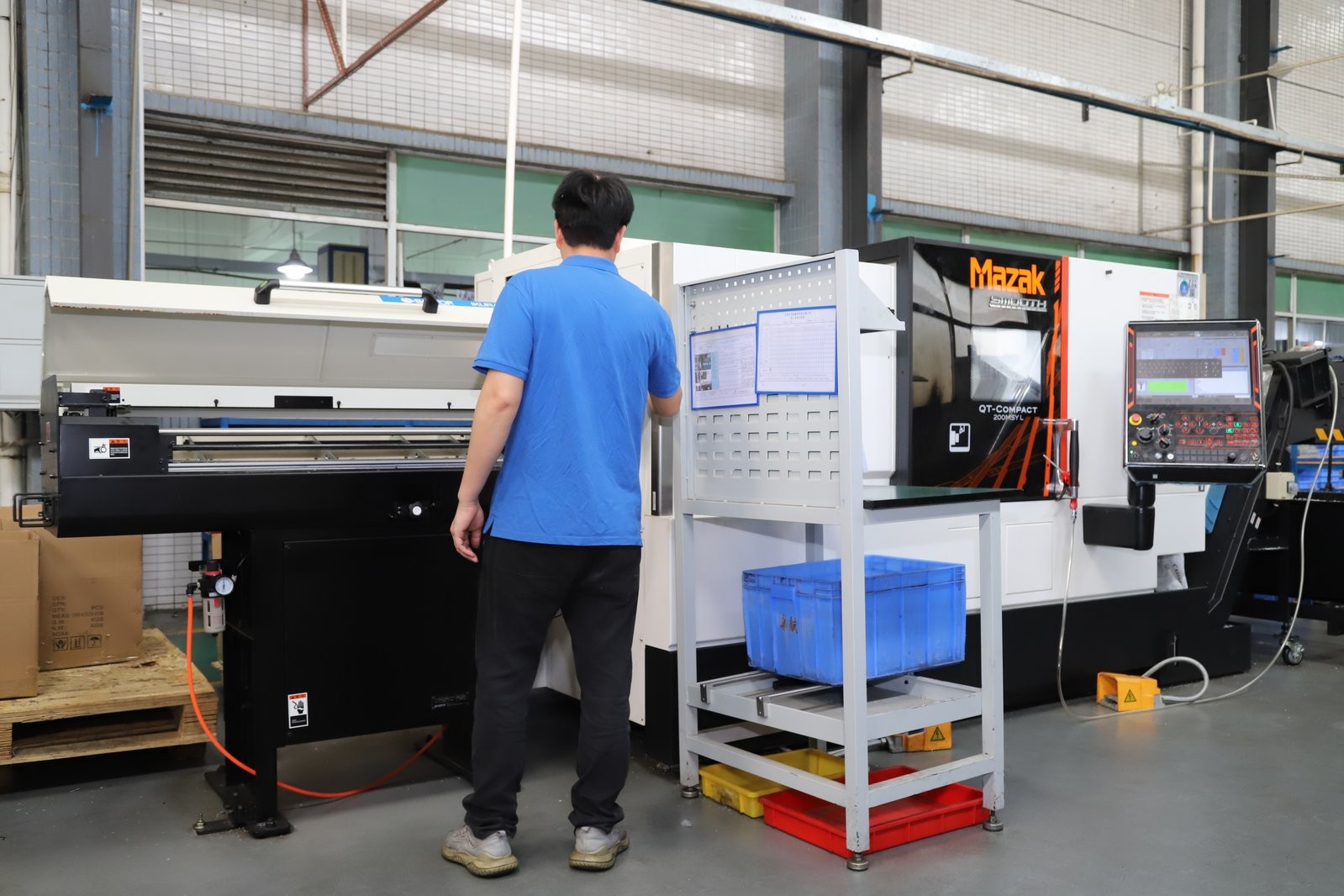
Mill-turn 5-axis — the sub-spindle advantage on a shaft
The sub-spindle on a mill-turn 5-axis machine (Mazak INTEGREX I-250H S) is the second spindle that catches the part when the main spindle finishes the first end, allowing the machine to turn, mill, and finish the second end without unloading. A shaft with features on both ends used to require two lathes (or a manual flip); the sub-spindle does the flip in-cycle, eliminating the re-fixture error. The savings on a 5-piece shaft at concentricity within 5 µm: $200-500 in setup and 30-50 percent in tolerance miss. The sub-spindle is the difference between a mill-turn that finishes both ends in one clamping and one that requires a manual flip.
Mill-turn 5-axis — the counter-spindle on a long shaft
The counter-spindle on a mill-turn 5-axis machine (Mazak INTEGREX I-250H S) is the second spindle that catches the part when the main spindle finishes the first end. A long shaft with features on both ends used to require a manual flip and re-fixture; the counter-spindle does the flip in-cycle, eliminating the re-fixture error. The savings on a 5-piece long shaft at concentricity within 5 µm: $200-500 in setup and 30-50 percent in tolerance miss.
- Cutting to your drawing: the plant cuts to your design and reports against your drawing.
- 6,800 m² across two buildings in Hengli Town, Dongguan. Production, inspection, and engineering under one roof.
- Mill-turn: Round parts that also need milled flats, cross-holes, off-axis bosses, or keyways, hydraulic fittings, connectors, shafts with clocked features.
- Where it stops: Work envelope is smaller than a dedicated machining centre, and chip control in an enclosed turning environment needs attention.
- Prototype and production run on the same floor and the same process.
What mill-turn changes about the process
Mill-turn is a machine that combines a turning spindle with milling capability and live tooling.
The part is completed in one clamping. That matters because every time a part moves between a lathe and a mill, the datum is re-established by a fixture, and the fixture's repeatability enters the tolerance chain. Removing the transfer removes that term.
How is the toolpath verified before it touches material?
Every programme is simulated offline before it reaches a machine: tool and holder collision, axis limits, and material removal against the stock model. On five-axis and mill-turn work this is not optional. The number of possible collision cases grows with each rotary axis, and a crash on a part that has already absorbed eight hours of cycle time is the expensive kind.
The verification step belongs in the quote. It is real engineering time, and a supplier that omits it is either simulating badly or not simulating at all.
What to ask before believing a mill-turn claim
Ask which features are completed in the single clamping and which, if any, need a second operation. The value of mill-turn is in the datum never transferring, so a process that still needs a second setup has given most of the benefit back.
None of these questions are hostile and all of them are cheap. A plant with the capability answers them easily; a brochure cannot.
What design decisions move the cost on 5 axis CNC milling?
Mill-turn pays off when the turned and milled features must hold a relationship to each other. Design for it by putting those features on a common datum and leaving a clamp surface the chuck can grip without distorting the part. Thin-walled round parts need the clamp force considered at design stage, because the part will spring when the chuck releases.
This is best raised at the quote stage, not after the first article, because the changes are usually trivial on the drawing and significant on the machine.
How much capacity sits behind it?
over a hundred machines with depth in every relevant family, 50+ three-axis, 20+ four-axis, 20+ five-axis, 25+ turning centres, plus Swiss-type, grinding, and wire EDM.
What do the certificates actually cover?
Three certificates, each with a number you can check with the registrar:
| Standard | Certificate number | Scope note |
|---|---|---|
| ISO 9001:2015 | 116024/A/0001/UK/En | Quality management system |
| IATF 16949:2016 | 131941/A/0001/SM/En | Automotive QMS. Excludes clause 8.3 product design |
| ISO 14001:2015 | 116024/B/0001/UK/En | Environmental management system |
The IATF 16949 certificate excludes clause 8.3 (product design). That is normal for a build-to-print manufacturer and it is stated here rather than left for an auditor to discover: we cut to the drawings you provide, it does not originate the design.
Where does mill-turn pay off on 5 axis CNC milling?
Round parts that also need milled flats, cross-holes, off-axis bosses, or keyways. Hydraulic fittings, connectors, shafts with clocked features.
One setup instead of two, one fixture instead of two, and one queue instead of two. The saving is in the schedule as much as in the hourly rate.
The honest boundary of mill-turn
Work envelope is smaller than a dedicated machining centre, and chip control in an enclosed turning environment needs attention.
This boundary is stated deliberately. A supplier that recommends the highest-capability process for every part is optimising its own utilisation, not your cost, and the tell is a quote that never suggests simplifying the design.
What tolerance applies?
±0.003 mm on CNC milling, ±0.002 mm on CNC turning; ±0.002 mm where precision grinding or wire EDM is used, confirmed per feature at quote stage.
What identifies the legal entity behind the machines?
Legally this is Dongguan Zhuohang Ltd, established 2005, Social Credit Code 91441900MA4UWT6X39, operating under the name Zhuohang Precision Machining Factory from No. 8, Shuibian Songyuan Road, Hengli Town, Dongguan, Guangdong, China 523470.
The 18-character code, checked against the National Enterprise Credit Information Publicity System, confirms a real manufacturer. A trading company may hold a business licence as well, but its scope is trading, not manufacturing, and its address is an office rather than a plant.
Mill-turn 5-axis — the multi-feature shaft in a single clamping
Mill-turn 5-axis is the configuration that combines a turning spindle, a B-axis milling head, and a sub-spindle, and the advantage is single-clamping on parts that combine turning and 5-axis milling. A shaft with a milled flat, a bore, external threads, and compound-angle features used to require three machines (lathe, mill, drill press) and three setups, with the cumulative tolerance stack-up each setup introduces. A mill-turn 5-axis machine turns, mills, drills, taps, and interpolates compound curves in one clamping, eliminating the re-fixture error and cutting the lead-time from 3-5 weeks to 1-2 weeks.
The cost: mill-turn 5-axis at $80-180 per hour is the most expensive configuration; the savings on a multi-feature shaft at 5 pieces is $200-500 in setup and 30-50 percent in tolerance miss. The break-even: parts with both rotational and prismatic features at any quantity; parts with only one feature class are cheaper on dedicated machines.
The Mazak INTEGREX I-250H S on this floor is the mill-turn 5-axis machine — a B-axis milling spindle (24 kW, 124 N·m), a counter-spindle, and an automated tool changer. The machine holds ±0.002 mm on turned features and ±0.003 mm on milled features in the same clamping, with thermal stability that keeps the tolerance across the 1-2 hour cycle. If you need a multi-feature part at concentricity within 5 µm, you should pick the INTEGREX; if you need a single-feature part, you can accept a dedicated machine.
The decision between mill-turn 5-axis and two-machine: a part with a turned OD and a milled flat at concentricity within 5 µm is a mill-turn part; the same part at ±0.1 mm is a two-machine part. The cost trade-off: mill-turn at $80-180 per hour versus a CNC lathe at $40-60 plus a VMC at $40-60; on a 5-piece prototype at 30 minutes per part, mill-turn costs $200-450 versus $120-180 for two machines. The mill-turn is more expensive per hour but eliminates the re-clamp tolerance miss.
De-risking a first order
Start with a handful of parts to confirm the routing and the tolerance, then scale. The same machines, the same inspection bench and the same certificate numbers apply to a single piece and a production run alike, so a small first batch is the proof that a large one will hold the same numbers.
What this shop actually runs
We machine every part in our own 6,800 m² plant in Dongguan, China, on 100+ CNC machines with 100+ staff. The machine list by category:
- 5-axis machining centres (10+) - Mazak VARIAXIS I-600 (510/910/510 mm travel, 12,000 rpm, 22 kW, 71.6 N·m, 30-tool BT40) and Mazak INTEGREX I-250H S (B-axis 0.0001°, 24 kW, 124 N·m, 38-tool HSK-A63). Suited to compound-angle parts, single-setup multi-face prismatic work, and aerospace fittings where datum transfer loss is unacceptable.
- 3-axis / 4-axis machining centres (50+) - Brother SPEEDIO S500Z2N / S700Z2N (10,000 rpm, 14/21-tool ATC, 0.7 s tool-to-tool, Z-axis 2.2 G) and Mazak VCE-430A L / VCE-570C L (10,000 rpm, 118 N·m, 24-tool ATC). Suited to prismatic parts, plates, brackets, housings.
- Swiss-type turning centres (10+) - Citizen Cincom A20-3F7 (Φ20 mm, 10,000 rpm), TSUGAMI B0206-III / B0205-III (Φ20 mm, 0.1 µm), STAR SR-32JII / SR-32J Type N (Φ32 mm, 8,000 rpm). Suited to long, slender rotational parts at ±0.002 mm.
- CNC turning centres (20+) - HEADMAN T70M/1250 (720 mm swing, 117 mm bore, 3,000 rpm, BMT75 12-station turret). Suited to shafts, bushings, flanges up to ±0.002 mm.
- Wire EDM (5+) - Sodick AQ535L (550/350/300 mm travel, ±20° taper, 800 kg workpiece). Suited to hardened tool steel, internal splines, sharp internal corners that milling cannot reach.
- Inspection: Hexagon CMM + 20+ gauges - Hexagon CMM for coordinate measurement, plus vision system, profilometer, hardness tester, coating thickness gauge, XRF for material verification. The 10:1 rule (gauge 10x more accurate than the band) is applied to every feature.
- Machine highlights - VARIAXIS I-600: one-setup multi-face 5-axis + MAZA-CHECK auto-calibration; INTEGREX I-250H S: DONE-IN-ONE mill-turn, B-axis 0.0001° + Ai thermal shield; SPEEDIO S500Z2N / S700Z2N: Z-axis 2.2 G + 0.7 s ATC; Swiss-type: guide-bush switchable + 0.1 µm resolution.
Tolerance: ±0.003 mm CNC milling / ±0.002 mm CNC turning / ±0.002 mm grinding and wire EDM. Capability: Ppk >= 1.67 initial on key characteristics, Cpk >= 1.33 ongoing.
Certificates: ISO 9001:2015 (116024/A/0001/UK/En), IATF 16949:2016 (131941/A/0001/SM/En, with design clause 8.3 excluded, stated openly) and ISO 14001:2015 (116024/B/0001/UK/En), issued to Dongguan Zhuohang Ltd, registration 91441900MA4UWT6X39, founded 2005.
Where we ship: Austria, Belgium, the Czech Republic, Denmark, France, Germany, Greece, Hungary, Ireland, Italy, the Netherlands, Spain, Sweden and the United Kingdom in Europe; Brazil, Canada, Mexico and the United States in the Americas; China, Israel, Japan, Singapore and Sri Lanka in Asia; Australia and New Zealand in Oceania; and South Africa in Africa — plus other countries and regions worldwide, shipped from our base in Dongguan, China.
Contact: Felipe Iglesias, [email protected], +86 13126536955.
Get a quote with the cost drivers named
Send your drawing to [email protected] or call +86 13126536955. We will tell you which tolerance or setup is driving the number, not just the number.
Frequently Asked Questions
Can you work to ASME Y14.5 as well as ISO?
Yes. Both geometric dimensioning conventions are used. The important thing is that the drawing states which one applies, because the same symbol can mean different things under the two standards.
Do you hold stock or consignment for repeat orders?
Repeat orders can run against a forecast so stock and, where the part warrants it, dedicated fixturing are held ready. This is a commercial arrangement, not a standard term, so raise it at the second order rather than the first.
When is mill-turn the right choice?
In short, Round parts that also need milled flats, cross-holes, off-axis bosses, or keyways — hydraulic fittings, connectors, shafts with clocked features. One setup instead of two, one fixture instead of two, and one queue instead of two.
Is your IATF 16949 certificate valid for design work?
No. The certificate excludes clause 8.3 (product design). The plant is certified to manufacture to your design and to run the associated process controls, not to originate product design.
Can mill-turn work scale from prototype to production?
Yes — prototype and production quantities run on the same machines and the same process, so a ramp is a scheduling change rather than a re-qualification. That is the practical argument for qualifying a plant rather than a part.
Do you sign NDAs before reviewing drawings?
Yes — an NDA can be signed before any files change hands, and drawings stay inside the quoting system rather than circulating by email.
Is inspection documentation included in the quote?
It should be stated explicitly. A first-article report is a document someone has to produce, and whether it is a full dimensional report or a sample plan changes both the cost and what you receive.
When is mill-turn a defensible choice?
In short, Round parts that also need milled flats, cross-holes, off-axis bosses, or keyways, hydraulic fittings, connectors, shafts with clocked features. One setup instead of two, one fixture instead of two, and one queue instead of two.
Continue reading: Mill Turn 5axis CNC Milling · 3 Axis CNC Milling · 4 Axis CNC Milling
Standards referenced on this page
- ASTM A582/A582M-12 — Standard Specification for Free-Machining Stainless Steel Bars
- ISO 14001 — Environmental management systems — Requirements with guidance for use
- IATF 16949:2016 — Automotive quality management system standard