
How do ordering and minimums work?
What is your minimum order quantity for 5 axis parts?
The MOQ is 1 piece. We take single-part prototypes and low-volume runs and scale into production, so you can validate complex geometry before committing to volume.
Can I order prototypes before a production run?
Yes. A 1-piece MOQ means the prototype stage is not gated by a production minimum. You can test the geometry and tolerance first, then place the volume order once the design is confirmed.
How fast will my parts ship?
What are your lead times?
Roughly 3, 7, or 30 days depending on part complexity and the number of process steps. Simple parts ship in about 3 days; parts with many operations or surface finishing fall into the 30-day tier.
Why do lead times vary instead of being one fixed number?
Lead time is set by the real workload — the number of process steps, the material, and any finishing. A single fixed promise would be a guess, so we quote a tier that matches the part and hold it.
How do I get a quote?
How do I get an accurate quote?
Send a STEP or IGES model plus a 2D drawing with material, tolerances, and surface finish, along with quantity and target date, to [email protected]. The quote includes a DFM review and a realistic date.
What information do you need for a quote?
A 3D model (STEP or IGES), a 2D drawing (PDF) with material and tolerances, the quantity, and your target date. With that, we can count the setups and process steps and return a date that holds.
What tolerances and materials do you work with?
What tolerances can you hold?
±0.003 mm on CNC milling, ±0.002 mm on CNC turning, and ±0.002 mm for precision grinding. Critical dimensions are verified on Hexagon CMMs with Ppk ≥ 1.67 at the initial study on key characteristics and Cpk ≥ 1.33 on general characteristics. Capability is reported per characteristic: every report names the feature, its tolerance band, the sample size, the sigma method, and the study window.
Which materials do you machine?
Aluminum, stainless steel, carbon and alloy steel, brass, copper, titanium, and magnesium, plus engineering plastics such as PEEK and POM. Every incoming lot is XRF-checked against its mill certificate.
Are you certified, and can I audit?
Are you certified?
Yes — ISO 9001:2015, IATF 16949:2016, and ISO 14001:2015, each with a certificate number you can verify with the registrar. IATF 16949 scope excludes product design under Clause 8.3.
Can I visit or audit the factory?
Yes. The facility is at No. 8, Shuibian Songyuan Road, Hengli Town, Dongguan, Guangdong, China 523470, and on-site or video audits are welcome.
How do payment, finishing, and IP protection work?
What payment terms do you accept?
T/T and L/C are standard, and other terms are negotiable. Prototype and sample charges, when they apply, can be credited against a later production order.
What documentation do I receive with my parts?
Material certificates, CMM inspection reports, and SPC charts ship with your order. Incoming material is XRF-verified against the mill certificate, so every part is traceable to its raw material lot.
Can you bundle surface finishing and heat treatment?
Yes — anodizing, plating, powder coating, painting, brushing, and polishing can be bundled with heat treatment. In-house ovens reach 500 °C; titanium stress relief above that is outsourced.
How is my intellectual property protected?
Drawings and models are never shared without written permission, and a mutual NDA is signed and returned if you provide one. Sensitive files are stored on encrypted media.
What if a part arrives non-conforming?
We remake parts found defective under normal use, and the traceability system identifies the lot, machine, and operator so the root cause is fixed rather than repeated.
Which materials and industries do you cover?
We machine aluminum, stainless steel, titanium, brass, copper, and Inconel, plus engineering plastics including PEEK and Delrin. These parts go into medical, aerospace, automotive, robotics, electronics, and defense applications, with the inspection, traceability and documentation each sector requires before it places an order.
Deeper questions buyers actually ask before placing a 5-axis CNC milling order
Beyond the basic FAQ on materials and lead-time, the questions that decide whether a 5-axis order goes ahead are the ones that touch cost structure, setup amortisation, tolerance verification, and risk. The answers below are what you should expect from a shop that runs a real quality system on 5-axis lots.
What is the difference between 3+2 positioning and simultaneous 5-axis on this part? 3+2 positioning locks the B-axis and rotary table at a fixed angle, then runs 3-axis milling — the right answer for housings with features on five flat faces. Simultaneous 5-axis moves the B-axis and rotary table during the cut — the right answer for impellers, blades, and compound curves where the tool must stay tangent to the surface. The cost: simultaneous 5-axis at $80-150 per hour is 20-40 percent more than 3+2 at $70-120; the cycle time on a compound-curve part is 30-50 percent shorter on simultaneous, which pays back the premium. A shop that quotes "5-axis" without specifying the strategy is one whose quote is ambiguous; one that quotes the strategy is one whose quote holds.
What does Cpk ≥ 1.33 mean on a 5-axis part? Cpk is the ratio of the tolerance band to the process spread. Cpk 1.33 means 3 defective parts per thousand (no shift assumption, 63 ppm at 1.5 sigma shift); Cpk 1.67 means less than 1 per 10,000. On a 5-axis part the relevant index is Ppk (preliminary, short-term) on the FAI, with Ppk ≥ 1.67 on critical features and ≥ 1.33 on general features; Cpk applies to production runs after stability is demonstrated. The number is the shop's honesty receipt — a shop that reports it is measuring the process; one that cannot is not. Ask for the tolerance band the index was computed against, because Cpk without a band is meaningless.
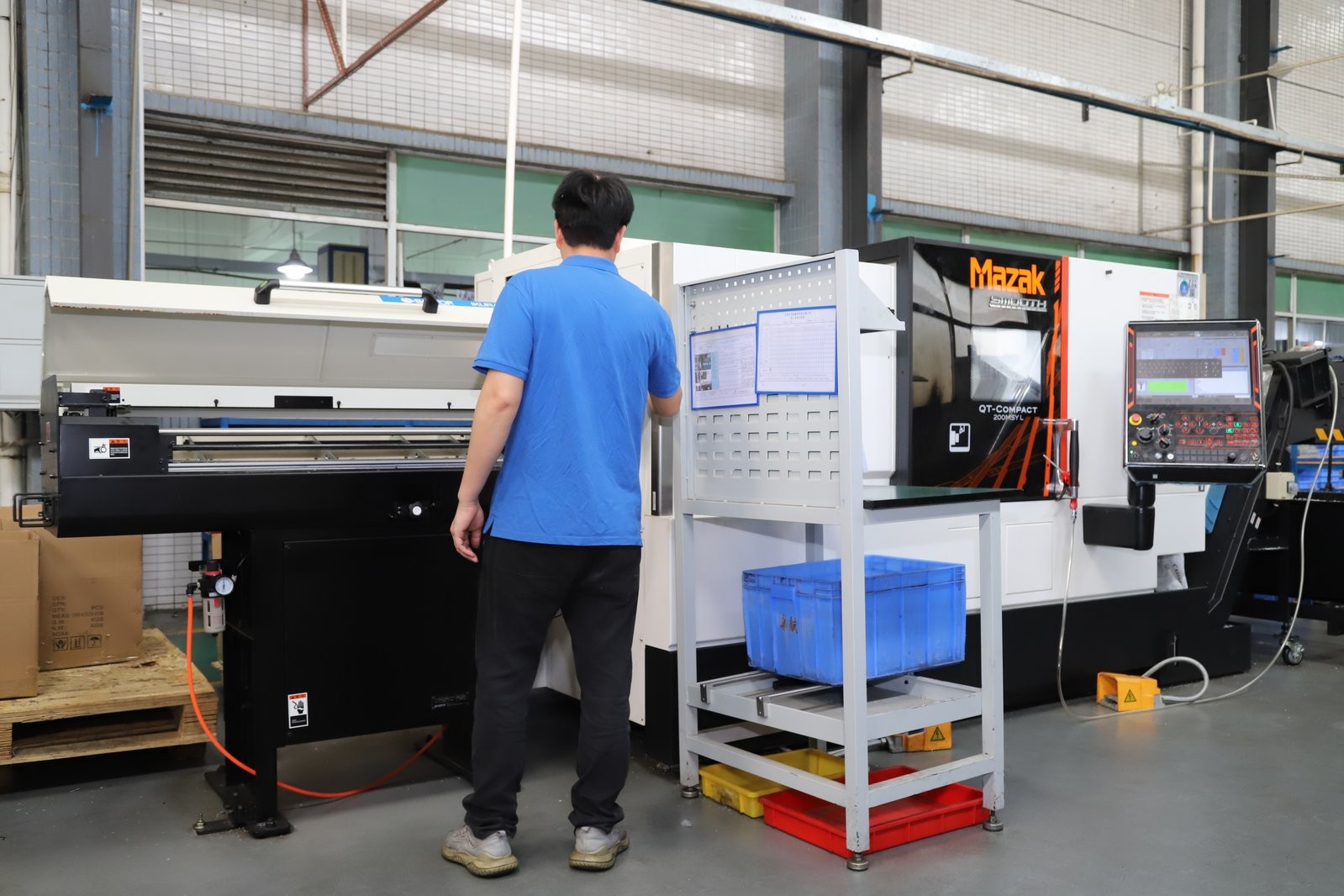
How do I verify a shop's 5-axis capability? Ask for the machine list by class and brand: Mazak VARIAXIS I-600 (vertical 5-axis machining centre, B-axis head + rotary table), INTEGREX I-250H S (mill-turn with B-axis milling spindle + counter-spindle). Ask for the spindle power and torque (VARIAXIS 22 kW / 71.6 N·m, INTEGREX 24 kW / 124 N·m), the control (Mazak Matrix or Fanuc), the thermal compensation (scale feedback), and the CMM (Hexagon, 10:1 measurement-to-tolerance). A shop that produces all five is one whose 5-axis is documented; one that produces "5-axis" without the spec is one whose capability is opaque.
What is PPAP, and when do I need it on a 5-axis part? Production Part Approval Process is the automotive industry's documentation package. On a 5-axis prototype you may need elements (control plan, capability study) but not the full package; the full PPAP applies to production. A shop that quotes "PPAP included" on a prototype is bundling documentation you do not yet need; one that quotes it as a production-stage add-on is the honest structure.
What files do you need for a 5-axis quote? A 3D model (STEP or IGES) plus a 2D drawing that carries the tolerances, surface finish callouts, material specification, and the datum scheme (ASME Y14.5 or ISO 1101). The drawing is the contract; the model alone leaves the tolerance scheme unspecified, and a quote built on the model alone is one whose tolerance risk sits with the buyer.
How do you handle re-clamp tolerance on a 5-axis part? 5-axis holds cross-feature tolerance in a single clamping, eliminating the re-clamp error that 3-axis accumulates across multiple setups. On a part at ±0.05 mm true position with 4 re-clamps on 3-axis, the cumulative stack-up is 200-400 µm — enough to risk the tolerance outright. 5-axis holds the same features in one clamping with no stack-up. The buyer who needs cross-feature tolerance at ±0.05 mm on a 4-face part should pick 5-axis; one who needs tolerance on one face only can accept 3-axis.
What happens if the 5-axis first article fails inspection? The shop holds the lot, documents the failure mode, and re-runs at no charge. A shop that ships a failed 5-axis FAI is one whose quality system is broken; one that holds and re-runs is one whose system works. You should require the FAI report before the production run starts.
What is the difference between 5-axis rapid prototype and 5-axis production? The difference is setup amortisation, not process. The same Mazak VARIAXIS I-600 runs the same tolerances (±0.003 mm), but with setup amortised across 1-10 pieces instead of 1,000-10,000. The unit price is 5-10× higher; the lead-time is 5-10 days instead of 4-8 weeks; the fixture is soft (vise, soft jaws) instead of hard (purpose-built).
The risk questions buyers should ask before placing the first 5-axis order
Beyond cost and lead-time, the risk questions decide whether the first 5-axis order starts a long sourcing relationship or a one-off mistake.
Who owns the program, the fixture, and the inspection data? you own all three on a documented quality system; the shop owns them on a quote-mill. You should ask: does the CAM file ship with the parts on request? Does the fixture stay at the shop for repeat orders or ship with the parts? Does the CMM report ship as standard? A shop that ships all three is one whose work is your property; one that retains them is one whose work is the shop's.
What are the payment terms on a 5-axis prototype? Standard: 50 percent deposit with order and 50 percent on shipment, or 100 percent for first-time buyers. A shop that asks for 100 percent before production starts is one whose risk is on the buyer. You should negotiate net-30 after the second or third order.
What is the re-run policy on a failed 5-axis FAI? The shop should hold the lot, document the failure mode (dimension, root cause, corrective action), and re-run at no charge. A shop that ships a failed lot is one whose quality system is broken; one that holds and re-runs is one whose system works.
What is the communication channel and response time? Standard response on a 5-axis quote is 4-8 hours; on a production issue, 1-2 hours. A shop with a multilingual contact (Felipe Iglesias, +86 13126536955, [email protected], PT/EN/FR/ES/ZH/JP) is one whose communication is anchored to your language.
What is the IP protection on the 5-axis drawing? The shop should sign an NDA on request, keep the drawing in-house (not forward to subcontractors), and not show the design to other buyers. The buyer with a patent-pending 5-axis design should require the NDA before sending the drawing.
The risk questions are the ones that decide whether the 5-axis order is the start of a long sourcing relationship or a one-off mistake. The shop that produces signal answers is one whose quote is anchored to reality; one that produces brochure answers is one whose quote is whatever it is.
The signal vs brochure answers on a 5-axis quote
The signal answer to "what tolerance can you hold" is "±0.003 mm on 5-axis milling, ±0.002 mm on turning, with a Cpk report"; the brochure answer is "tight tolerances." The signal answer to "what machine will my part run on" is "Mazak VARIAXIS I-600 for the 5-axis features, TSUGAMI B0206-III for the Swiss features"; the brochure answer is "high-end machines." The signal answer to "what certifications do you hold" is "ISO 9001:2015 116024/A/0001/UK/En, IATF 16949:2016 131941/A/0001/SM/En, ISO 14001:2015 116024/B/0001/UK/En"; the brochure answer is "ISO certified." A shop that produces signal answers is one whose 5-axis quote is anchored to reality; one that produces brochure answers is one whose quote is whatever it is.
The IP protection on a 5-axis drawing
The IP protection on a 5-axis drawing: NDA signed before the drawing is sent, the drawing kept in-house (not forwarded to subcontractors), the design not shown to other buyers, and the program/fixture/inspection data shipped with the parts on request. A shop that produces all four is one whose custom 5-axis work is anchored to the buyer; one that produces none is one whose work is whatever the operator does. The buyer with a patent-pending 5-axis design should require the NDA before sending the drawing.
What payment methods and terms do you accept?
PayPal, Western Union, and bank or wire transfer. For long-term customers we also accept Net 30, Net 45, and Net 60 terms after an approved credit review.
What happens if a machined part has a manufacturing defect?
We provide free repair or remake for parts with manufacturing defects. All repair and remake costs, including return and shipping, are on us.
How quickly do you respond to inquiries?
We respond to every inquiry within 24 hours. Quotations for standard parts are returned within 48 hours; print reviews and DFM feedback are usually back within one business day.
Have a question not covered here?
Email [email protected] or call +86 13126536955 — we answer directly.
Standards referenced on this page
- ASTM B348/B348M-21 — Standard Specification for Titanium and Titanium Alloy Bars and Billets
- IATF 16949:2016 — Automotive quality management system standard
- ASTM B211/B211M-19 — Standard Specification for Aluminum-Alloy Rolled or Cold Finished Bar, Rod, and Wire